
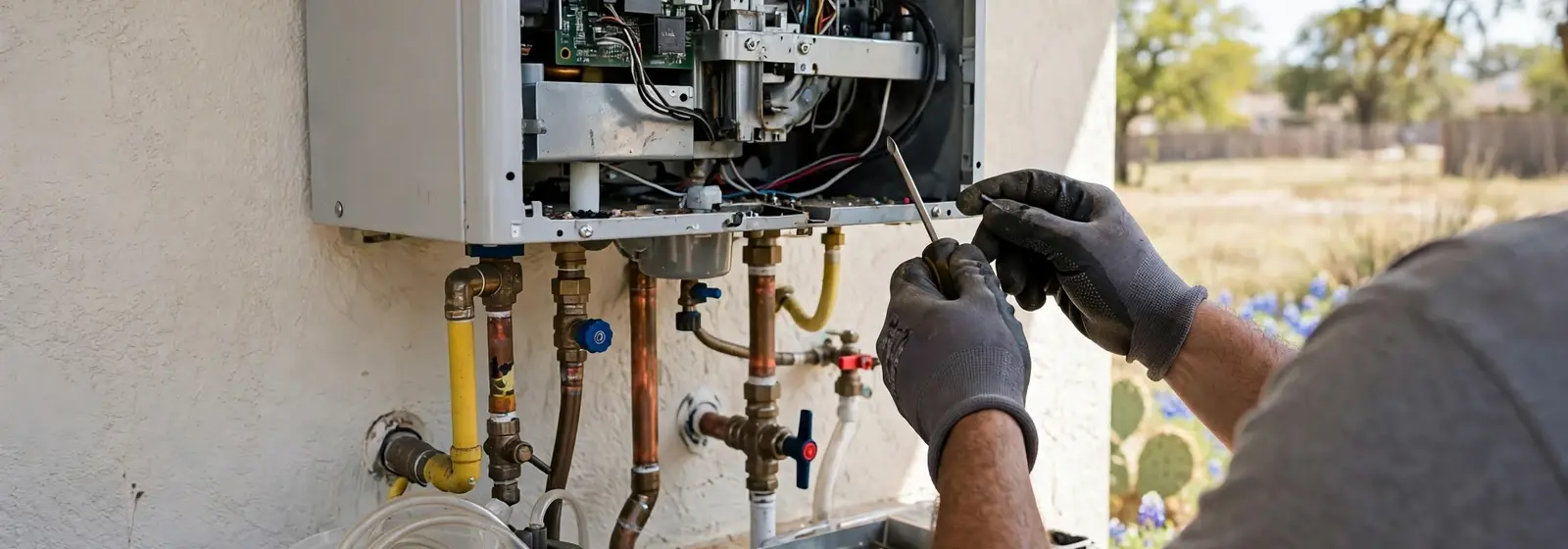
This is a planned-service page, because most tankless work is a scheduled install or a maintenance flush. If a unit has stopped and you need hot water now, call anyway, and we will tell you on the phone whether it is a quick fix.
Compare this with tank installation if you are choosing, and with water heater repair if you suspect an ordinary tank is the issue.
Descaling and flushing: the job most people skip
A tankless unit's heat exchanger has narrow passages. Mineral scale narrows them, makes the unit work harder and eventually triggers error codes or cold spots. A flush circulates a descaling solution through the unit, typically with a small pump and hoses, and clears that buildup.
Manufacturers publish their own intervals, and the right one depends on water hardness. Fountain Utilities lists about 165 ppm hardness in winter and about 350 ppm in summer, so follow the maker's guidance and lean toward more frequent flushing.
Many callers want to know what the flush involves
We connect a pump to the isolation valves, run the solution through for the time the manufacturer specifies, rinse the unit and check the inlet filter. Units without isolation valves can have them added at the same visit.
Common tankless problems
| Symptom | Likely cause | Typical action |
|---|---|---|
| Cold sandwich, hot then cold then hot | Scale or flow too low to trigger the heater | Flush, clean the inlet filter |
| Error code on the display | Ignition, flame, vent or flow fault | Diagnose the code, repair or reset |
| Water does not get hot enough | Scale, undersized unit, gas supply issue | Flush, check the gas pressure and sizing |
| Condensate backing up | Blocked drain or failed condensate pump | Clear the line, replace the pump |
| Leak at the unit | Failed fitting, heat exchanger or valve | Locate the source, repair or replace |
If a heat exchanger has failed, the cost of repair is often close to replacement. We tell you that before you commit.
Condensate pumps and venting
High-efficiency condensing tankless units produce acidic condensate and need a drain. When the drain cannot run downhill, a small condensate pump lifts it away. If the pump fails or the line clogs, the unit may shut down on a fault. We replace pumps, clear drains and neutralize condensate where required.
Venting is the other half. Condensing units use plastic venting that must be sealed and sloped correctly, and a poorly installed vent can cause nuisance faults.
Replacing a tank with a tankless unit
What usually changes on a conversion
- The gas line often needs to be larger to supply a higher burner rating.
- Venting changes, often to plastic or stainless, and may route to a new exit point.
- Electric tankless units may need heavy electrical service.
- A water softener may be recommended to protect the heat exchanger.
- A permit and inspection are required for the installation, per the State Plumbing Board.
A 2025 bulletin from the Colorado State Plumbing Board says water heater installations need permits and inspection and must be done by a licensed plumber under a registered contractor. The Pikes Peak Regional Building Department at 719-327-2880 serves Fountain. We handle the permit steps in our installs.
Tankless in Fountain homes
Whether your home is in a newer neighborhood such as Lorson Ranch or Mesa Ridge or in an older one near Downtown Fountain, a tankless unit needs the right gas supply and venting, and a conversion from a tank needs a look at both. Either way, the first question is hard water, and we explain whether a softener is worth discussing. See water softener and filtration.
What tankless service costs
Price factors
- Service type
- A flush is a short visit, a conversion is a larger project.
- Unit brand and model
- Parts and procedures differ.
- Isolation valves
- If missing, adding them is part of the job.
- Gas, venting and electrical
- Conversions often need upgrades.
- Scheduling
- Planned visits are scheduled at your convenience.
We give a clear price before work starts. Call (719) 530-4349 to schedule a flush or ask about a new unit.
Standards, venting and the manual
Tankless units are listed by safety labs and must be installed to the manufacturer's instructions, including approved vent materials for condensing models. Gas piping falls under rules such as NFPA 54, and a tankless unit often needs a larger gas line than a tank. According to the U.S. Department of Energy, tankless heaters can last more than 20 years with proper maintenance.
Where we work
We service tankless units in Fountain, Security-Widefield and the Fort Carson area.
Tankless Water Heater questions in Fountain, CO
Follow the manufacturer's schedule, and in hard water such as Fountain's, lean toward the shorter interval.
Scale or low flow can stop it from firing steadily. A flush and a clean inlet filter often fix it.
The state plumbing board says installations need permits and inspections. Call 719-327-2880.
Yes, subject to gas, venting and electrical needs. We assess them on a visit.
A small pump that lifts acidic condensate to a drain when the unit cannot drain by gravity.
Yes. See the Security-Widefield and Fort Carson pages.