
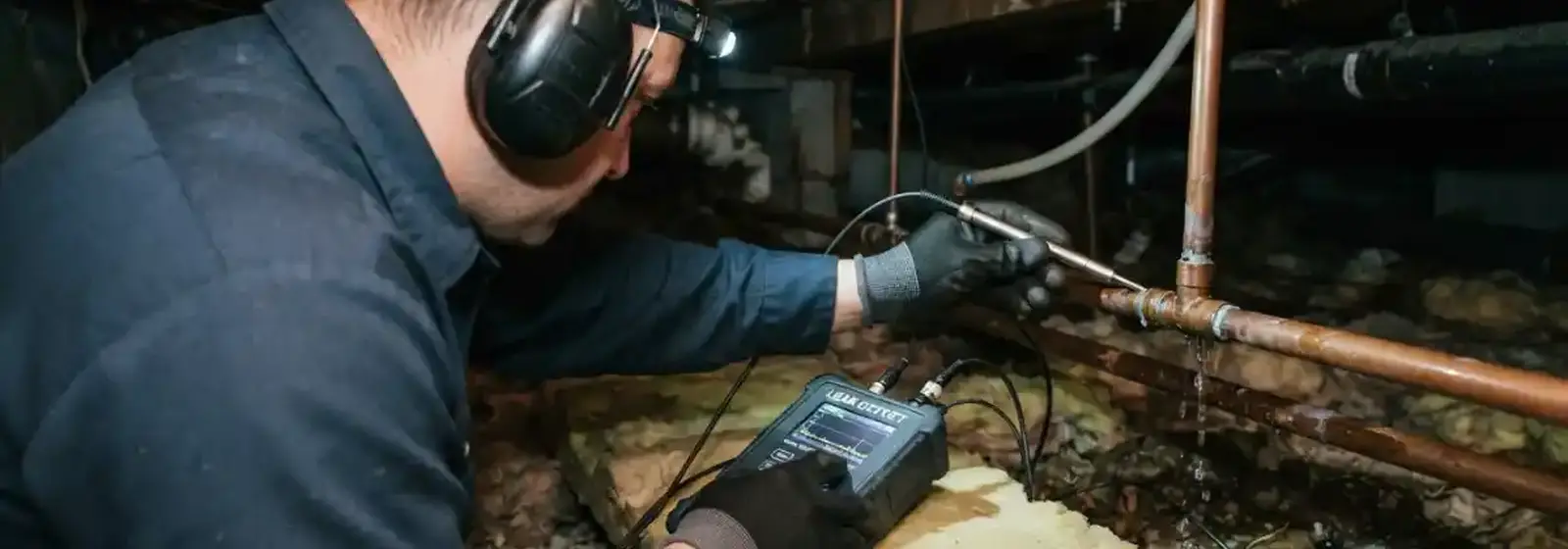
Most leak calls do not start with the word leak. They start with a symptom: a water meter that keeps turning with every tap closed, a bill that climbed with no explanation, a warm patch on the floor, a stain that spreads on a ceiling, or the sound of running water at night. The job is to find the leak without opening more of the house than we have to.
This page explains how that works, from a simple meter test to listening gear and thermal imaging, and what to do with the result. A leaking water heater is covered on the water heater repair page and a burst line on burst pipe repair.
Is it leaking? The two-minute meter test
Check before you call
- Turn off every tap and appliance that uses water, including the ice maker, and make sure no one is running the washer or dishwasher.
- Find the water meter, usually in a box near the street, and look at the leak indicator or the dial.
- Note the reading, wait fifteen minutes without using water, and look again.
- If it moved, water is going somewhere. Shut the main valve at the house and see if the meter stops, which tells us whether the leak is before or after the valve.
That last step matters. A meter that keeps moving with the main valve closed points to the service line between the meter and the house, while a meter that stops points to leaks inside the home. Fountain Utilities can be reached at (719) 322-2000 with questions about your meter or your bill.
How we find a hidden leak
| Method | Best for | What it tells us |
|---|---|---|
| Pressure test | Isolating a section of the plumbing | Whether the loss is in the supply, the hot side or the cold side |
| Acoustic listening | Pipes under slabs, behind walls, buried lines | The location of the sound a leak makes |
| Thermal imaging | Hot water leaks, radiant lines, wet drywall | Temperature differences that show moisture or hot pipe |
| Moisture meters | Walls, floors, ceilings | How far the dampness has spread |
| Tracer gas | Hard-to-hear leaks | A harmless gas travels to the leak and is sensed on the surface |
| Camera | Drain lines, cavities | A direct view of a pipe or cavity |
We do not start with a hole in your wall. Each tool narrows the search, and the final step is a small, targeted opening only where the leak is confirmed.
High bill, running meter and slab leaks
A high water bill is often the first sign of a leak that has been running for weeks. Toilets that run, irrigation lines, a pinhole in a copper pipe and a leaking service line all show up the same way on a bill. The meter test above is the quickest way to rule in or out a leak.
A slab leak is a leak in a pipe running beneath or within a concrete floor. Callers describe a warm spot on the floor, the sound of running water with everything off, or water coming up along a wall. Slab leaks are located with acoustic gear and thermal imaging, and repaired by rerouting the line, spot repair or repiping, depending on its condition. See repiping if more than one leak has appeared.
Water service line, yard and meter box leaks
The water service line runs from the meter to the house. A leak there may show as a soft spot in the lawn, a pooled patch, or an unusual drop in water pressure. Callers sometimes suspect it because the meter keeps running with everything shut off inside. We pinpoint the leak with acoustic equipment and explain whether a spot repair or a line replacement makes sense.
Yard and irrigation leaks are separate. A broken sprinkler line or a failed valve can run for weeks and cost a lot on a bill, and we check the system as part of the job when it is the likely cause.
Ceiling, wall and crawlspace leaks
Signs of a leak you cannot see
- A brown or yellow stain on a ceiling that grows after you use a bath or shower upstairs.
- Drywall that is soft, bubbled or cool to the touch.
- A musty smell in a closet, a basement corner or a crawlspace.
- Baseboards that swell or flooring that cups.
- Water noises when nothing is running.
These leaks can start at a supply fitting, a drain joint, a failed shower pan or a leaking appliance connection. Moisture follows gravity and can show up far from the source, so the stain is a clue to start from, not an address.
Fountain homes, water and ground conditions
Fountain Utilities says its 2024 testing found a 90th percentile copper level of 0.35 ppm and notes it cannot control the materials in home plumbing. That is a reminder that what sits inside your walls is your side of the meter. Pinholes, failed fittings and worn fixture connections are the usual suspects when a hidden leak turns up, in homes around Downtown Fountain and Cross Creek as anywhere.
Leaks can come from supply lines and fixture connections as well as from pipe wear, in newer subdivisions such as Lorson Ranch and Mesa Ridge as in older streets. Properties near Fountain Creek can also have damp ground that complicates the search for a buried leak.
What a leak detection visit costs
Price factors
- Scope
- Checking one wall is quicker than tracing a buried line.
- Equipment
- Basic listening gear and thermal imaging are different levels of work.
- Access
- Finished floors and tile make finding the exact spot more delicate.
- Repair
- Detection and repair are quoted separately, so you see both numbers before work starts.
- Hour of the call
- Emergency dispatch outside business hours is priced for the hour.
Insurance usually covers sudden damage and often excludes slow leaks, so photos and a written finding help a claim. For your number, call (719) 530-4349.
Commercial buildings and property managers
We find leaks in shops, offices and rental properties, and we coordinate with property managers. Call us early. A commercial leak often involves a landlord, a tenant and an insurer, and a clear written finding speeds up the paperwork. See commercial plumbing.
Reference points for leak testing
Pressure testing is the standard way to prove a piping system is tight, and model codes such as the IPC and UPC describe test requirements for new work. According to the EPA's WaterSense program, the average household's leaks can waste nearly 10,000 gallons of water a year, which is why a quiet meter check is worth doing.
Where we find leaks
We work across Fountain, in Security-Widefield, and in the Fort Carson area.
Leak Detection questions in Fountain, CO
Yes. We are open 24/7. Shut the main water valve and call (719) 530-4349.
Warm spots on the floor, a meter that runs with everything off, the sound of water and unexplained wet flooring are common signs.
Only when needed and only in the confirmed spot. We use listening, thermal and moisture tools to avoid exploratory holes.
Possibly. Do the meter test. If it moves with everything off, there is a leak somewhere.
Fountain Utilities at (719) 322-2000. Ask about its process for leak-related bills.
Yes. See Security-Widefield and Fort Carson.