
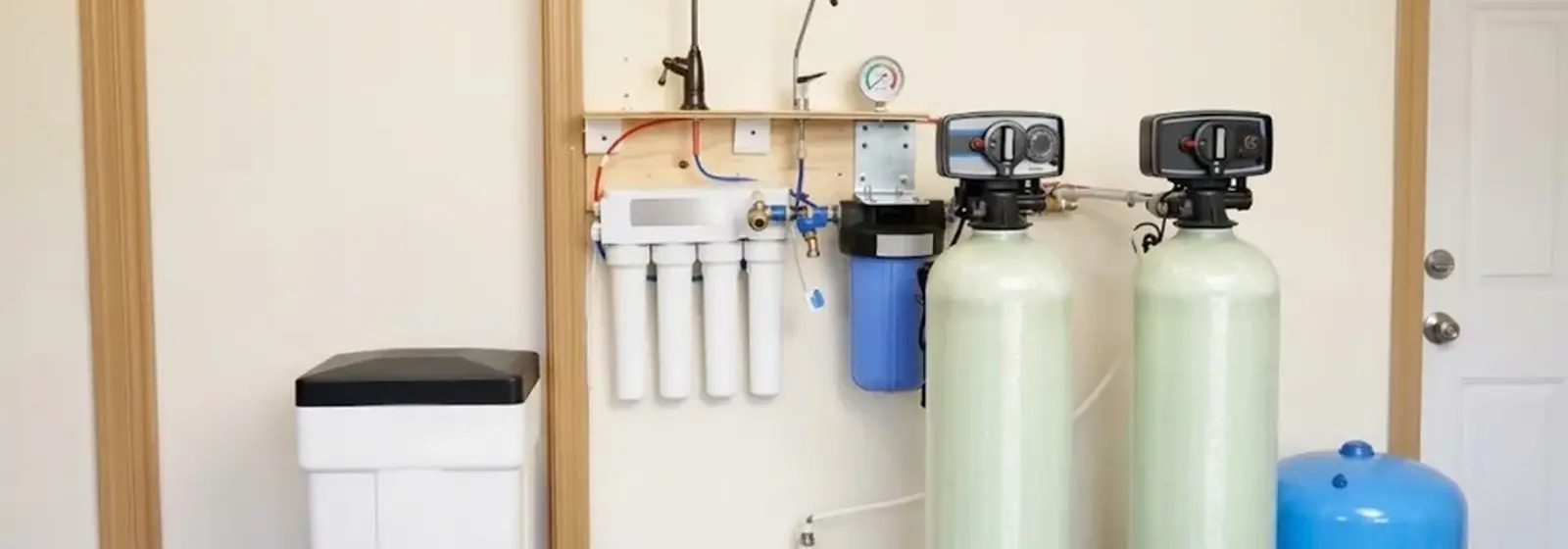
We install, service and repair water softeners and talk through whole-house filtration. A softener changes how water behaves in your pipes, heater and fixtures. A filter removes particles or specific contaminants. They are different tools, and the right choice depends on what you want to fix.
If hard water is wearing on your heater, see water heater repair and tankless water heaters. This is planned work, so it is scheduled and not dispatched as an emergency.
What the numbers mean
| Season | Hardness (ppm) | Grains per gallon | City's suggested softener setting |
|---|---|---|---|
| November through April | About 165 | About 10 | 10 |
| May through October | About 350 | About 20 | 20 |
The city page notes that one grain per gallon equals 17.1 ppm and that these figures assume iron at 1 ppm or less. On common scales, water at 165 ppm counts as hard and water at 350 ppm counts as very hard.
That swing means a softener's regeneration settings matter. A unit set for 10 grains uses too little salt in summer, and one set for 20 wastes salt in winter. We help set a schedule that follows the season.
What hard water does to your plumbing
Effects you may notice
- White scale on faucets, showerheads and glass.
- Sediment in water heaters and scale on electric elements.
- Scale buildup in tankless heat exchangers.
- Soap that does not lather well and leaves a film.
- Spots on dishes and glassware.
- Narrower drain traps and pipes over time.
These effects are cumulative. A softener will not undo existing scale in your pipes, but it slows the buildup of new scale.
Softener or filter: which one
Water softener
Uses ion exchange to swap calcium and magnesium for sodium or potassium. It reduces scale. It is not a drinking water filter.
Sediment filter
Catches particles such as sand and rust. Often installed ahead of other equipment.
Carbon filter
Reduces chlorine taste and odor and some organic compounds.
Reverse osmosis
A point-of-use system that treats drinking water at a tap. It can remove many dissolved substances.
If you are concerned about a specific contaminant, read your utility's annual water quality report and choose treatment that is certified for that contaminant. Fountain Utilities can be reached at (719) 322-2000 for its report.
Installing and servicing a softener
What a visit covers
- We check your hardness, the iron level if known and the household's water use.
- We size the softener for that demand and choose a location with a drain and power.
- We install a bypass valve, the brine tank connection and the drain line.
- We program the regeneration schedule, test the output and explain refills and upkeep.
For an existing unit that is not softening, common causes are an empty brine tank, a salt bridge, a clogged injector, a failed control valve and exhausted resin. We diagnose which.
Fountain homes and where the softener goes
A softener needs a spot with a drain and power, and a garage or basement utility area works well. A softener should not sit where it can freeze. In a newer home in Lorson Ranch or Mesa Ridge you may find a spot already prepared, and an older house near Downtown Fountain may need piping and a drain added. We look before we quote.
Fountain Utilities' 2024 report says its sources include surface water from the Fountain Valley Authority and the Southern Delivery System plus groundwater. Hardness can shift with the blend, which is another reason to check the city's published figures and not assume one number.
Cost factors
What shapes the price
- Unit size and type
- Capacity is matched to your household.
- Installation complexity
- New drain, power and piping increase the job.
- Add-ons
- Filters, bypass valves and plumbing loops add cost.
- Service
- Repairs vary with the part.
We give you the price before work starts. Call (719) 530-4349.
Standards for treatment equipment
NSF/ANSI 44 covers residential cation exchange water softeners, and NSF/ANSI 53 and 58 cover filters and reverse osmosis systems for specific contaminants. The U.S. Geological Survey classes water from 121 to 180 mg/L as hard and anything above 180 as very hard, which puts Fountain's winter and summer figures in those two bands.
Where we work
We serve Fountain, Security-Widefield and Fort Carson. Water in Security-Widefield comes from different districts than Fountain's, so hardness may differ there.
Water Softener & Filtration questions in Fountain, CO
Fountain Utilities lists about 165 ppm, or 10 grains per gallon, from November through April and about 350 ppm, or 20 grains per gallon, from May through October.
No. It reduces scale-forming minerals. Filtration is for specific contaminants.
The city suggests settings of 10 and 20 for winter and summer. We help you program it.
Softeners add small amounts of sodium or potassium. Ask your doctor if you are on a restricted diet.
Often yes. We check the brine tank, injector, control valve and resin.
Yes. See Security-Widefield and Fort Carson.