
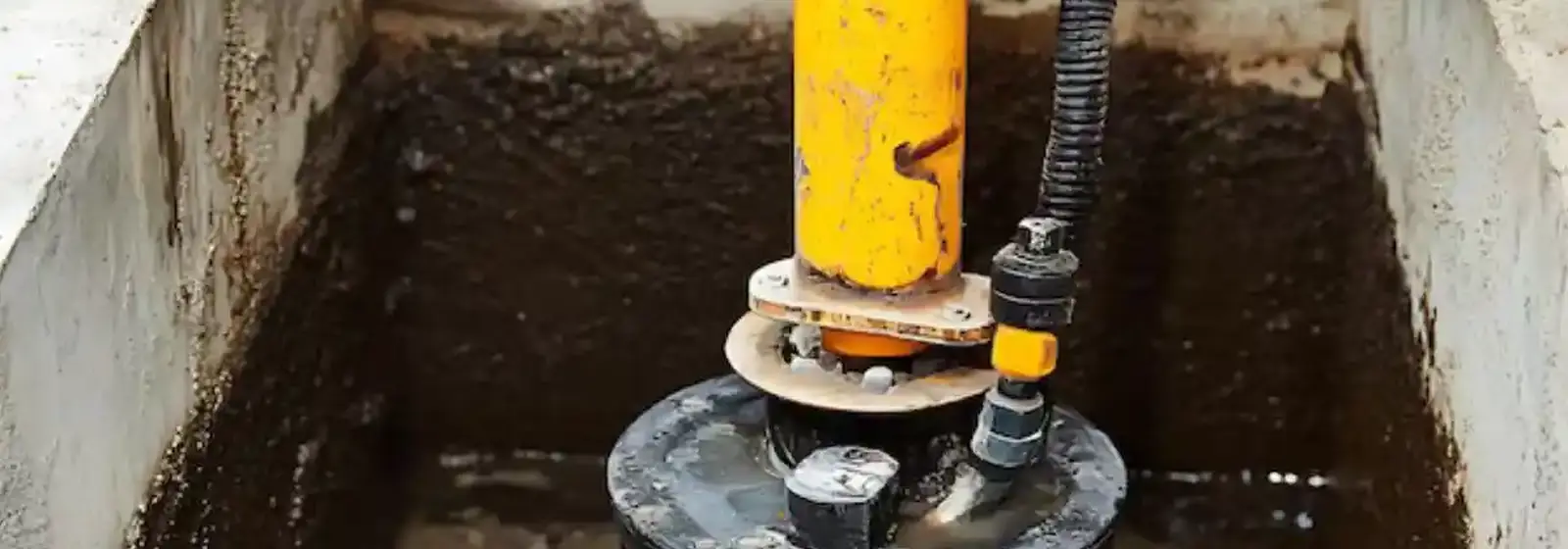
Many homeowners think of the pump as the whole system, but most failures trace back to the pit, the discharge or the power supply. A premium pump in a poorly built pit will still flood your basement.
This guide walks through each part, covers pump types and backups and explains what a plumber does during an install. If your basement is wet now, call us first. We handle emergency pump failures around the clock.
The pit
The pit, also called a basin, sits below the floor. It must be deep enough for the pump to turn on and off without short cycling, and sealed or lidded so that debris and radon-bearing soil gas do not enter the room. Many pits have perforated sides to take in water from the surrounding gravel.
If there is no pit, a plumber cuts the slab, digs a hole, sets the basin in gravel and patches the floor. If you already have one, we check its size, its condition and whether it is clear of silt.
Choosing a pump
| Pump | Strength | Trade-off |
|---|---|---|
| Submersible | Quiet, sits in the pit, handles heavy flow | Harder to reach for service |
| Pedestal | Motor sits above the pit, easy to service | Louder and takes more room |
| Battery backup | Runs when the power is out | Needs battery care and testing |
| Water-powered backup | Uses city water pressure, no battery | Uses water and depends on pressure |
Size the pump to the water you expect. A pump that is too small cannot keep up in a storm, and one that is too big can short cycle. Look at the pump's flow at the height it must lift the water.
The discharge line
Discharge pipes carry water out of the house. They need a check valve to stop water falling back into the pit, a slope that drains rather than traps and an outlet that sends water well away from the foundation.
Discharge checks
- The outlet should not dump near the foundation, where water can soak back in.
- It should not send water onto a neighbor's lot.
- It should not freeze solid in cold weather, since an iced outlet leaves the pump pushing against a plug.
- The pipe should be supported and sealed where it passes through the wall.
Backup and alarms
Storms knock out power, and a sump pump that needs electricity stops when it is needed most. A battery backup runs a second pump when the main one cannot. A high-water alarm tells you when the pit is rising.
Test both on a schedule. Pour a bucket of water into the pit and see whether the pump starts and the water goes out the discharge.
Installation steps
What a plumber does
- Check the pit location and the lowest point of the basement or crawlspace.
- Set or inspect the basin, with gravel and a lid.
- Place the pump on a stable base, set the float and connect the check valve.
- Run the discharge pipe to a safe outlet and seal wall penetrations.
- Wire or plug in the pump and add a backup and an alarm if chosen.
- Test with water, cycle the pump and confirm the float works freely.
See sump pump installation and repair for what we do, and basement water control for the wider picture.
Care and testing through the year
A sump pump sits idle for long stretches, and idle parts stick. A short routine keeps it ready. Test it each season and after heavy rain, and look at the pit for silt and debris.
A seasonal routine
- Pour water into the pit and confirm the pump starts and empties it.
- Check that the float moves freely and the check valve clicks shut.
- Look at the outlet outside and clear leaves, ice or debris.
- Test the backup and replace its battery on the maker's schedule.
Pump listings and radon
Sump pumps are commonly listed to UL 778. According to the EPA, homes below the third floor should be tested for radon, and a sump pit can let soil gas in, so a sealed lid is worth having. Ask your installer about both when you choose the basin.
What a sump pump cannot do
A pump handles water that reaches the pit. It will not fix a foundation crack, a failed gutter system or surface runoff pouring against a wall. If water enters in the middle of a wall, other work may be needed. We will tell you if it is beyond plumbing.
Fountain note: Fountain Creek and storm history
Fountain Creek flows south through the city, and the U.S. Geological Survey has published a report on the September 2013 flooding in the Fountain Creek basin. That report is a useful background if your lot is low or near the creek corridor.
Not every Fountain home has a sump. If yours does, test it before the wet season. If you are near Fort Carson or in Security-Widefield, the same advice applies.
Questions homeowners ask
Well away from the foundation and not onto a neighbor's lot. Avoid a spot that freezes shut.
If the power goes out in storms or your basement has flooded, yes.
Pour water into the pit and see whether the pump starts and empties it.
No. It depends on the lot, the drainage and the history of the house.
Where to go next
For a new pit or a failed pump, see sump pump installation and repair. For other sources of basement water, basement water control explains our scope.
A pump that stopped in the middle of a storm is an emergency, and (719) 530-4349 is answered during storms too. We serve Fountain, Security-Widefield and the area around Fort Carson.