
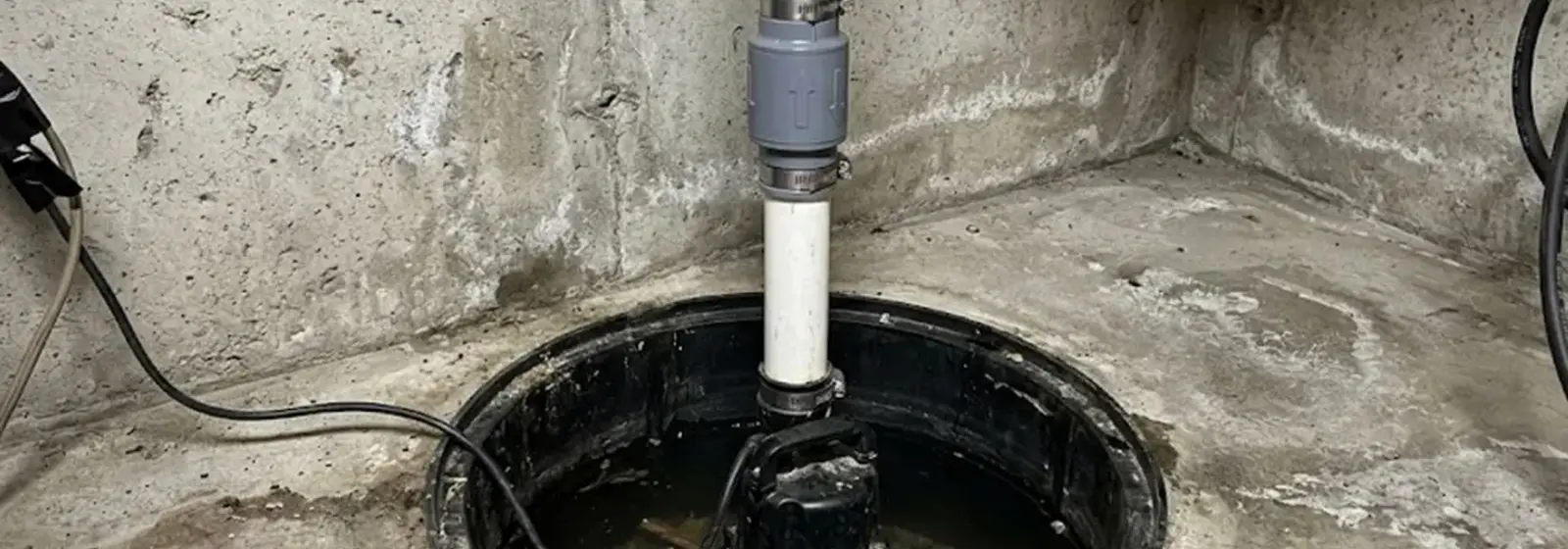
A sump pump collects water from a pit in the lowest part of a basement or crawlspace and sends it out through a discharge pipe. When it fails, the pit overflows, and groundwater can reach the floor in hours. The common causes are a stuck float switch, a clogged intake, a failed motor, a power outage and a blocked or frozen discharge line.
This page explains how we get a failed pump running, when a replacement or a battery backup is the better choice and what a new installation includes. A sewage ejector pump, which lifts waste from a basement bathroom, is a different machine, and we handle those too. For water entering through the foundation, see basement water control.
Pit filling or pump not running: first steps
Right now
- Look at the pit. If the water is rising and the pump is silent, check that it is plugged in and the breaker is on.
- Lift the float gently to see if the pump starts. If it does, the float is stuck and needs attention.
- Do not touch the pump or cord while standing in water. Turn off power to the area at the panel if you can reach it safely.
- Move stored boxes, furniture and electronics up off the floor, then call us.
We respond to sump failures at any hour, including during storms. Tell the dispatcher if the discharge hose runs outside, since a frozen or blocked outlet is a common reason a pump runs but moves nothing.
Why sump pumps fail
| Failure | Symptom | Fix |
|---|---|---|
| Stuck float switch | Pump will not turn on, or will not turn off | Free or replace the float or switch |
| Clogged intake | Pump runs, little water moves | Clean the intake screen and the pit |
| Failed motor | Hum or silence, hot pump | Replace the pump |
| Check valve failure | Pump short-cycles, water falls back | Replace the check valve |
| Blocked discharge | Pump runs, water backs up at the outlet | Clear or reroute the discharge line |
| Power loss | Pump quiet during a storm | Add a battery backup |
Sump pumps have a finite life. An old pump is a risk even if it still runs, and replacing it before the wet season is cheaper than a flooded basement.
Pump types and backups
Submersible pump
Sits in the pit, runs quietly, handles most homes.
Pedestal pump
The motor is above the pit. It is easier to service and louder.
Battery backup
A second pump on a battery runs when power fails, which is when many basements flood.
Sewage ejector pump
Lifts waste from a basement bathroom or laundry to the sewer line. It needs a sealed pit.
A water-powered backup does not need a battery, but it depends on utility water pressure and uses water. We recommend what fits your home.
Does your Fountain home need one?
Fountain Creek runs south through the city, and USGS has published a report on the September 2013 flooding in the Fountain Creek basin, so water near the creek corridor is a recognized concern. Not every house has a sump pit. Many Fountain homes with basements do, and some do not need one at all. A pit is more likely where a lot is low or the water table is high.
Some homes have a sump pit and some do not, in newer subdivisions such as Lorson Ranch and Mesa Ridge and in the older core near Downtown Fountain alike. A basement that has stayed dry can still get water after a heavy rain. We look at your pit and discharge before advising.
Installing a new sump pump
What a new installation includes
- Locate the lowest point and decide where the pit will sit, or evaluate the existing one.
- Set the pit, connect the interior drain if there is one, and install the pump on a level base.
- Run the discharge line to a point away from the foundation, with a check valve.
- Test the pump with water, set the float and show you how to check it each season.
Where the discharge goes matters. It should carry water away from the house and not toward a neighbor's lot, and in freezing weather the outlet should not trap ice.
Sump pump costs
Price factors
- Repair or replace
- A float switch or check valve is a smaller job than a new pump.
- Pump type and horsepower
- Higher flow and backup systems cost more.
- New pit or existing
- Digging a pit and concrete work add to the job.
- Discharge line
- Length and routing change the cost.
- Hour of the call
- Storm and after-hours calls are priced for the hour, with the figure stated first.
Check whether your homeowner policy covers sump overflow or only sudden water damage. Call (719) 530-4349 for a quote.
Standards for pumps and discharge
Sump and sewage pumps are commonly listed to UL 778, the safety standard for motor-operated water pumps. Where a discharge may go, and whether a sewage ejector needs a sealed, vented basin, are questions for the plumbing code and your local authority. Check the pump's label and the maker's manual before you buy.
Where we work
We repair and install pumps in Fountain, in Security-Widefield and near Fort Carson.
Sump Pump Installation & Repair questions in Fountain, CO
Yes. We answer 24/7, including during storms. Call (719) 530-4349.
It varies with use and quality, but an old pump is a risk even if it still runs. Test it each season.
If your basement has flooded or your area loses power in storms, yes. Backups run when the main pump cannot.
A stuck float, a failed check valve or a high water table. We diagnose which.
A pump that lifts waste from a basement bathroom to the sewer line. It is a sealed system and different from a sump pump.
Yes. See Security-Widefield and Fort Carson.