
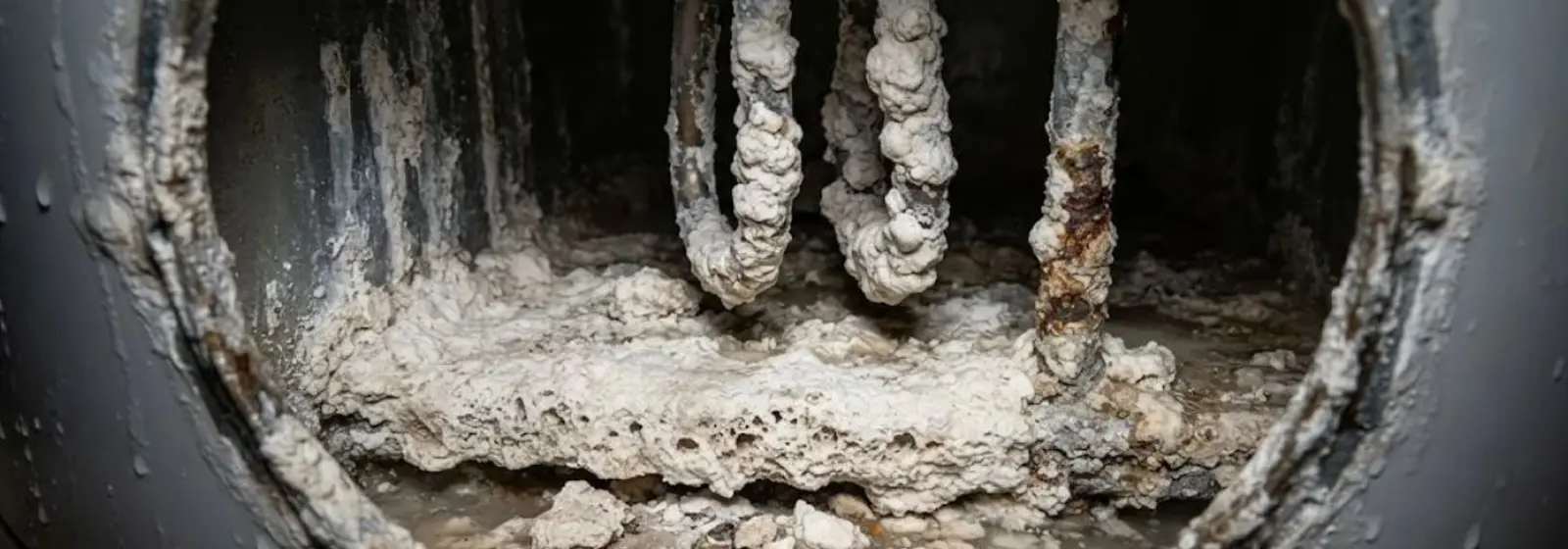
Fountain Utilities publishes its hardness. It is about 165 ppm, or 10 grains per gallon, from November through April and about 350 ppm, or 20 grains per gallon, from May through October. That is hard in winter and very hard in summer, which is why scale is a recurring theme in water heater calls here.
This guide explains how scale hurts a heater, what maintenance helps and how treatment such as a softener changes the picture.
What the numbers mean
| Season | Hardness (ppm) | Grains per gallon |
|---|---|---|
| November through April | About 165 | About 10 |
| May through October | About 350 | About 20 |
One grain per gallon equals 17.1 ppm. The city's page recommends softener settings of 10 in winter and 20 in summer. Those are the figures to use when you set a softener, and they show how much the water changes through the year.
Scale in a tank heater
Scale settles to the bottom of a gas tank and sits between the burner and the water. The burner has to heat through that layer, which wastes fuel and overheats the steel. On an electric tank, scale coats the lower element and makes it work harder until it burns out.
Signs of scale in a tank
- Rumbling or popping noises when it heats.
- Hot water that runs out sooner than it used to.
- Rusty or cloudy hot water.
- Elements that fail repeatedly.
- A tank that takes longer to recover.
Flushing a tank can remove loose sediment, and some manuals recommend doing it on a schedule. An old tank with heavy scale may not benefit, so ask a plumber before you try it.
Scale in a tankless heater
A tankless heater heats water in a small heat exchanger as it flows through. Scale narrows those passages and insulates the metal. The unit may show error codes, give less hot water or overheat.
Manufacturers describe a descaling procedure that circulates a mild acid through the exchanger. Follow your manual for the interval, since hard water calls for more frequent service. See tankless water heaters.
Anode rods and the tank
A tank has an anode rod that corrodes in place of the steel. Hard water and heat wear it down. When the rod is gone, the tank itself starts to rust. Checking the rod is one of the best ways to extend a tank's life, and a plumber can do it during a service.
Signs of scale around the house
The heater is not the only place where scale shows up. Look at showerheads, faucet aerators, the inside of the kettle and the glass shower door. White or tan crust and spotted dishes are scale you can see, and a water heater shows the same minerals in a place you cannot.
Quick checks
- Unscrew an aerator and look for crust.
- Look at the showerhead holes for blocked jets.
- Check the tank's drain valve for gritty sediment when you flush it.
- Notice whether soap lathers poorly and leaves a film.
Seeing scale at the fixtures is a good clue that the heater is collecting it too. Treating the water, flushing on schedule and servicing parts on time keep scale from turning into a failure.
Talking to a plumber about treatment
If you are considering a softener, ask what the plumber would set it to and how it will follow the season. Fountain's published numbers differ between winter and summer, and the unit's regeneration settings should reflect that. Ask where it will drain and how often you will refill the salt.
How hardness is classed
According to the U.S. Geological Survey, water is soft up to 60 mg/L, moderately hard from 61 to 120, hard from 121 to 180 and very hard above 180. Fountain's winter figure of about 165 ppm lands in the hard band and its summer figure of about 350 ppm lands in very hard.
What helps
Practical steps
- Know your heater's age and type and keep the manual.
- Flush a tank or descale a tankless unit on a regular schedule.
- Have the anode rod checked on a tank.
- Consider a water softener, see water softener and filtration.
- Replace a failing unit before it leaks, see water heater replacement.
A softener reduces the minerals that make scale. It does not remove every contaminant, and it needs salt and a schedule. We can talk through whether it fits your home.
Fountain note: where the water comes from
Fountain Utilities says its supply is mostly surface water, from the Fountain Valley Authority and the Southern Delivery System, plus groundwater from the Venetucci Project and wells. Hardness can shift with the blend, which is why the city publishes winter and summer figures.
For hardness details or a water quality report, call Fountain Utilities at (719) 322-2000. If you live in Security-Widefield, your water comes from a different district, so ask them for your numbers.
Questions homeowners ask
Fountain Utilities lists about 165 ppm from November through April and about 350 ppm from May through October.
Scale makes heaters work harder and can contribute to failure.
It can reduce scale. We can talk through your household and heater.
Many manuals recommend it. Ask a plumber about your unit's age and condition.
Where to go next
If you want to treat the water, see water softener and filtration. If your heater is struggling, start with water heater repair.
To talk through scale, flushing or a softener, call (719) 530-4349. We work in Fountain, Security-Widefield and near Fort Carson, where water sources differ by district.