
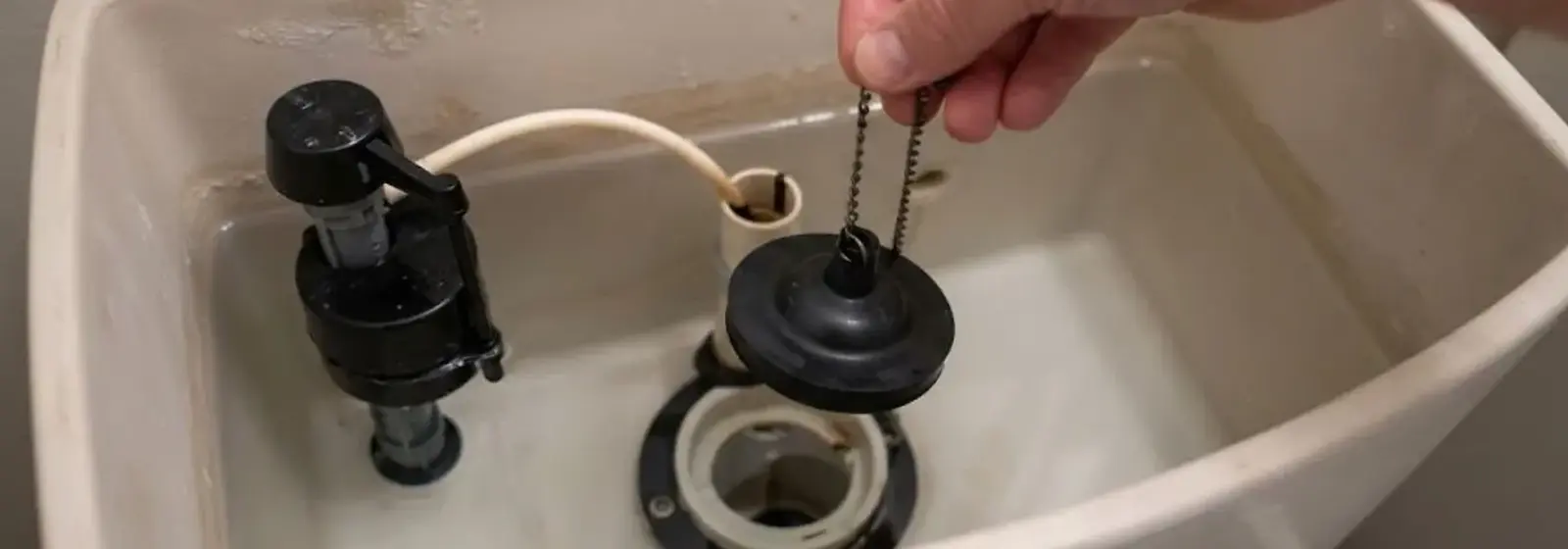
Start by lifting the tank lid and watching what happens when you press the handle. If the handle moves and nothing lifts inside, the chain is probably detached. If the handle itself wobbles, the mounting nut is loose. If it sticks, look for corrosion or a bent arm.
This guide covers each case, explains how to replace a handle and shows when the trouble is inside the tank, not on the handle itself.
How the flush handle works
The handle is on the outside of the tank. Inside, a lever arm is attached to it and the arm connects by a chain to the flapper, a rubber seal over the drain opening. Pressing the handle pulls the chain, lifts the flapper and lets water rush into the bowl.
When any part of that chain of parts fails, the toilet does not flush well. That is why diagnosing the symptom matters more than replacing parts at random.
| Symptom | Likely cause | Fix |
|---|---|---|
| Handle is loose and wobbles | Mounting nut loose | Tighten the nut |
| Handle moves, no flush | Chain off the arm or broken | Reattach or replace the chain |
| Handle sticks down | Bent arm or corrosion | Straighten or replace the handle |
| Weak flush | Chain too loose | Shorten the chain slightly |
| Toilet runs after flush | Chain too tight or flapper worn | Adjust the chain or replace the flapper |
Tightening a loose handle
Tighten the mounting nut
- Take the lid off the tank and set it somewhere safe.
- Find the nut on the inside of the tank where the handle goes through.
- Turn the nut by hand or with pliers. Note that many handle nuts have reverse threads, so turn clockwise to loosen and counterclockwise to tighten.
- Snug it up without cranking, since porcelain can crack.
If the nut keeps loosening, the handle or the nut may be worn, and a new handle is cheap.
Fixing the chain
The chain should have a little slack when the flapper is closed, about a half inch. Too much slack and the flapper does not lift fully. Too little and it cannot seat, which makes the toilet run.
Hook the chain to a different hole in the arm to change the length. If the chain is corroded or kinked, replace it. A chain can also tangle with the flapper, so check that it moves freely.
Replacing the handle
Swap in a new handle
- Turn off the water at the shutoff behind the toilet and flush to drain the tank.
- Disconnect the chain from the arm and unscrew the mounting nut.
- Pull the old handle out through the front and fit the new one.
- Tighten the nut, hook the chain with a little slack and turn the water back on.
Match the handle to your tank. Front-mount, side-mount and angle-mount handles are different, and the arm length differs too. Bring the old handle to the store if you are not sure.
Handle styles and finishes
Handles come in front, side and angle mounts, and in finishes such as chrome, brushed nickel and plastic. The mount style must match the tank, since the arm has to line up with the chain and the flapper. A side-mount tank, for example, will not work with a front-mount handle.
Metal handles can corrode where they meet water and humidity, and plastic ones can crack at the lever. If the finish is flaking, replace the handle rather than painting it. A new handle is inexpensive and takes only a few minutes.
Before you buy
- Note where the handle sits on the tank: front, side or corner.
- Check whether the arm is metal or plastic and how long it is.
- Take a photo of the inside of the tank to show at the store.
Water-saving labels on toilets
According to the EPA's WaterSense program, labeled toilets use 1.28 gallons per flush or less. If you replace a worn toilet and not only the handle, look for the label. A lower flush volume only works well if the flapper seals and the chain length is right, which is why the small parts matter.
When the problem is not the handle
If the handle works but the toilet keeps running, the problem is the flapper or the fill valve. If the bowl does not refill, the fill valve or the supply line is the suspect. If the toilet leaks at the base, a wax ring or a loose bolt is the likely cause.
Call a plumber if
- The tank is cracked or leaking from the body.
- Water seeps around the base of the toilet.
- The toilet clogs repeatedly, which can mean a line problem.
- You replaced the parts and it still runs.
Our toilet repair page covers what a plumber does for running, leaking and clogged toilets. Persistent clogs may need drain cleaning.
Fountain note: hard water inside the tank
Fountain Utilities lists about 165 ppm of hardness in winter and about 350 ppm in summer. Mineral deposits can build on the chain, the flapper and the fill valve, which makes parts stick or leak sooner.
If you open the tank and see white or orange crust, that is scale and rust. Cleaning it off helps, and replacing a worn flapper often cures a running toilet.
Questions homeowners ask
The arm may be bent or the handle may be binding against the tank. Straighten it or replace the handle.
Rarely. It is a simple part. Call if you find leaks or cracks.
Many handle nuts have reverse threads. Turn counterclockwise to tighten.
Mineral scale can stick flappers and fill valves. Check them if the toilet runs.
Where to go next
If the repair turns into a leak, a crack or a recurring clog, see toilet repair. A stubborn clog may point to the line, and drain cleaning is the fix.
Toilet trouble does not keep office hours. If it turns into a flood, call (719) 530-4349. We cover Fountain, Security-Widefield and Fort Carson.