
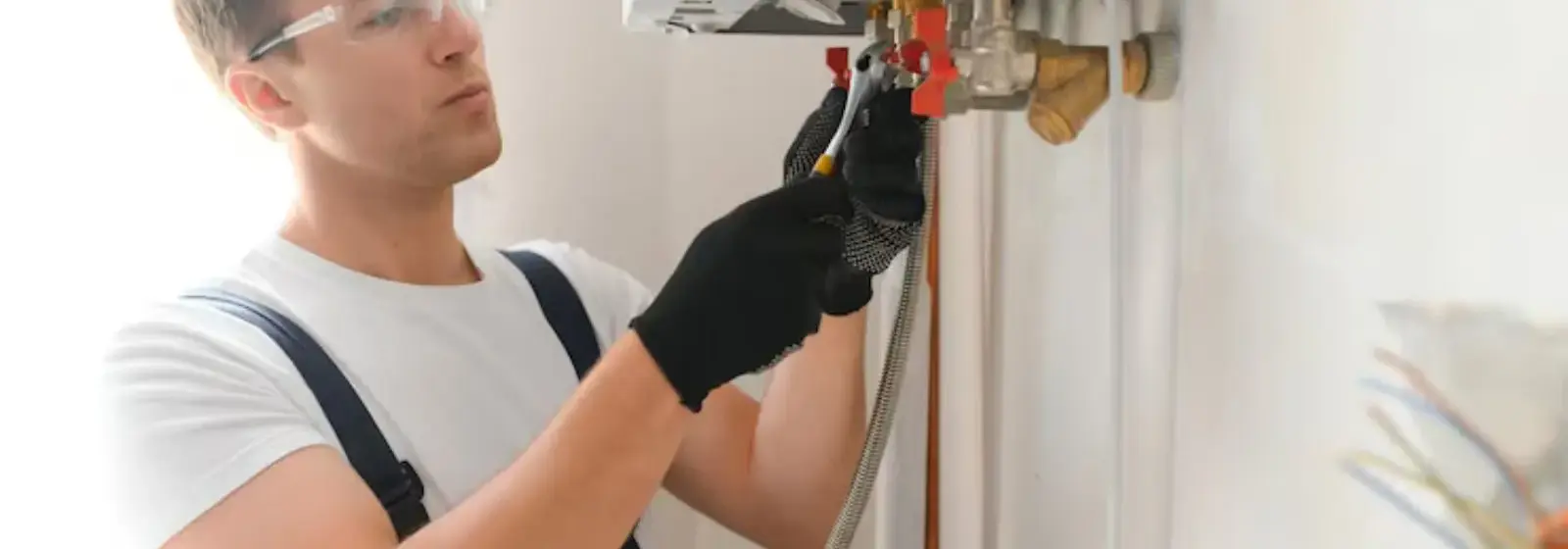
Tankless heaters have more joints and sensors than a simple tank, and they sit on a wall where a leak can run down into electronics and the floor. Quick action limits damage.
This guide covers the first steps, the common leak sources and the repairs that follow, including when a leak means a replacement.
First steps
Stop the leak
- Turn the heater off at its switch or breaker.
- Close the cold water supply valve to the heater.
- If it is a gas unit and you smell gas, leave the house and call the gas utility or 911.
- Place a bucket or towels to limit damage, and photograph the leak.
Do not run the unit with an active leak. Water can reach electrical parts and trip safeties or cause shorts.
Where the leak may be
| Location | Likely cause | Typical fix |
|---|---|---|
| Water inlet or outlet fittings | Loose or worn fitting or washer | Tighten or replace the fitting |
| Isolation valves | Worn valve or O-ring | Replace valve or seal |
| Condensate line or trap | Blocked or cracked condensate path | Clear or replace the line, see the manual |
| Pressure relief valve | Valve weeping from pressure or debris | Test, clean or replace |
| Bottom of the unit | Internal leak, possibly the heat exchanger | Professional diagnosis, may need replacement |
| Filter or screen | Loose cap or seal | Reseat the cap and check the seal |
A drip at a fitting is a simple repair. A leak from inside the cabinet is more serious, since parts inside may be damaged.
Scale and the heat exchanger
A tankless heater pushes water through narrow passages at high temperature. Mineral scale can build up and restrict flow, cause overheating and eventually damage the heat exchanger. Regular descaling according to the manual reduces that risk.
If your heater has not been descaled and starts leaking inside, scale damage is a suspect. A technician can inspect and tell you whether it is repairable.
Condensate leaks
Condensing models produce acidic condensate that drains through a line, often with a neutralizer and sometimes a pump. A kinked line, a full trap or a failed pump can cause water to spill near the unit. Your manual shows the approved condensate path, and our tankless service page explains what we check.
What to tell the technician
A short description speeds the visit and helps the plumber bring the right parts. Say where the water appears, when it started and whether it drips constantly or only when hot water runs. Mention any error codes and when the unit was last serviced.
Helpful details
- Make and model, found on the unit's label.
- Gas or electric, and condensing or non-condensing.
- Any error code shown on the display.
- Whether you have descaled it and when.
- Photos of the leak and the area underneath.
Keep towels and a bucket nearby, and leave the supply valve closed until the unit is checked. Moving fast on a leak protects the wall, the floor and the electronics.
If the unit is under warranty, keep the receipt and the installer's paperwork. A warranty may require installation by a licensed plumber, and in Colorado a water heater replacement needs a permit and inspection.
Preventing the next leak
Isolation valves are worth a mention. They let a technician flush the unit without draining the house, and they give you a quick way to shut the heater off from the plumbing. If yours are stuck or weeping, replace them at the next service.
Most leaks come from wear and neglect. Service the unit on the manual's schedule, descale it, replace worn isolation valves and keep the condensate path clear. A yearly look at the connections for moisture catches a drip before it becomes a puddle.
How long a tankless unit should last
According to the U.S. Department of Energy, tankless water heaters can last more than 20 years with proper maintenance and have replaceable parts. A leak in a unit well short of that is a reason to check the maintenance history, the warranty and the water quality before you decide to repair or replace.
Repair or replace
A repair is likely if
- The leak is at an external fitting or valve.
- The condensate line is clogged or loose.
- A seal or O-ring has worn out.
Replacement is more likely if
- The leak comes from inside the heat exchanger.
- The unit is old and parts are hard to find.
- The cost of repair approaches the cost of a new unit.
See tankless water heaters for repair and installation, and water heater replacement if a swap is needed. A new install requires a permit under a 2025 state plumbing board bulletin.
Fountain note: seasonal hardness
Fountain's published hardness is about 165 ppm in the cold months and about 350 ppm in the warm months, so scale shows up faster in summer. Scale forms faster at the higher level, so a descaling schedule matters more for tankless owners here.
If you have not had your unit serviced, ask for a scale check and read your manual for the interval.
Questions homeowners ask
It can be. Water near electrical parts or a gas smell are reasons to shut it off and call.
No. Shut it off and close the supply until it is checked.
Scale can damage the heat exchanger over time. Descale as the manual says.
Check the warranty terms. Many exclude damage from scale or poor maintenance.
Where to go next
If you have a leak, call us and read about tankless water heaters. For a unit past saving, see water heater replacement.
Shut the unit off, close the supply and call (719) 530-4349. We repair tankless heaters in Fountain, Security-Widefield and near Fort Carson.