
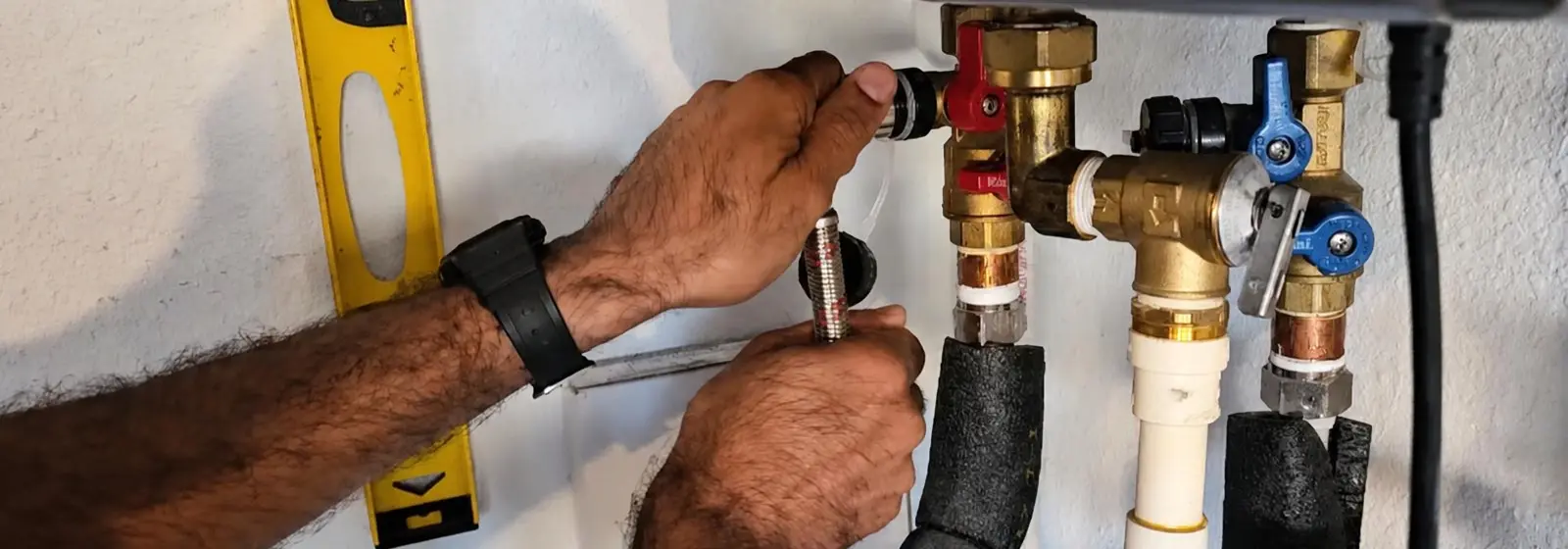
When the pump fails or clogs, the heater may show an error and shut down, or condensate can back up and leak. The pump is a small part, but a failed one stops hot water completely on many units.
This guide explains where condensate comes from, how the pump and neutralizer work, the signs of trouble and which fixes are safe for a homeowner.
Why a tankless heater makes condensate
Standard gas water heaters send hot exhaust up a flue. High-efficiency condensing units extract more heat from the exhaust, which cools it enough that water vapor turns to liquid. That liquid collects in the heater and must exit through a drain line.
Condensate from gas appliances is acidic. Many installations add a neutralizer, a small canister of media that raises the pH before the liquid reaches a drain. Check your manual, because requirements differ by model and local rules.
Where the pump comes in
If the heater is above a floor drain or a laundry standpipe, gravity moves the condensate along. If there is no drain at a lower level, a condensate pump collects the liquid in a small reservoir and pushes it up and out through a tube.
| Part | Job | Trouble sign |
|---|---|---|
| Drain line | Carries liquid from the heater | Kinks or sags that hold water |
| Neutralizer | Raises the liquid's pH | Spent media, needs replacing per the manual |
| Pump reservoir | Collects liquid | Sludge buildup, floats stuck |
| Pump and float | Moves liquid to a drain | Does not run, or runs constantly |
| Discharge tube | Takes liquid to the drain | Clogs or freezes |
Signs the pump is in trouble
What to watch for
- The heater shows an error code related to condensate or drainage.
- Hot water stops while the unit is powered.
- Water on the floor near the heater or the pump.
- The pump hums constantly or never runs.
- A sour smell near the unit.
Check your manual for the code list. Many errors point to a clogged condensate line, a blocked vent or a failed sensor, and only some involve the pump.
What you can safely do
Switch the heater off at its switch or breaker before touching anything. If the reservoir is dirty, you can often clean it and the float with the manufacturer's guidance. Check the discharge tube for kinks and blockages.
Avoid bypassing the neutralizer or draining condensate somewhere the manual does not allow. Acidic condensate can damage some pipes, and local rules may limit where it goes. Ask the building department if you are unsure.
Preventing condensate problems
Most condensate trouble is slow and preventable. Sludge collects in the reservoir, the neutralizer media wears out and the discharge tube kinks or clogs. A look once or twice a year catches these before they stop the heater.
A simple yearly check
- Read the manual for the neutralizer interval and mark your calendar.
- Look at the drain line for sags, kinks and slime.
- Check the pump reservoir for sludge and the float for free movement.
- Confirm the discharge tube still drains into an approved place.
- Run hot water and watch for error codes.
These checks pair well with descaling, since both are part of keeping a condensing unit healthy. If you would rather not open the unit, a service visit covers it.
Questions homeowners ask the installer
If you are buying a condensing tankless unit, ask where the condensate will drain and whether a pump is needed. A floor drain, a laundry standpipe or a utility sink may take it by gravity. Ask what neutralizer the maker requires and how you will know when it is spent.
Also ask who services the pump if it fails, and whether the warranty covers it. A pump is a small electrical part with a float, and it is one of the first things to wear out in a damp utility room.
Standards for tankless units and vents
Gas tankless heaters are commonly certified to ANSI Z21.10.3, and the manufacturer lists the vent materials its condensing models allow. Those instructions are part of the listing, so following them is part of a proper installation and part of keeping the warranty.
When to call
Call if the pump has failed, the heater keeps shutting down or you smell gas. The venting and condensate path are part of how a tankless unit is installed, so repairs should follow the manual. See tankless water heaters for what we service, and water heater repair for diagnosis.
What a service visit covers
- Read the error code and check the vent and condensate path.
- Test the pump and float and clean the reservoir.
- Check the neutralizer and replace spent media.
- Run the heater through a cycle to confirm it drains.
Fountain note: scale and the heat exchanger
The city's water page puts Fountain's hardness near 165 ppm in winter and near 350 ppm in summer. Hard water scales a tankless heater's heat exchanger, which can trigger errors that look like condensate problems.
Descaling on a schedule your manual suggests helps. If your errors recur, ask whether scale or the condensate path is the cause.
Questions homeowners ask
No. Only condensing models make condensate, and only some need a pump. A floor drain close by may be enough.
It is mildly acidic. Handle it with care and follow the manual and local rules.
Scale can cause heat exchanger errors that look similar. Fountain's hardness is a reason to descale.
Follow the manual. Intervals vary by model.
Where to go next
If you have a failing pump or a heater that keeps shutting off, read tankless water heaters and then call. For wider hot water trouble, see water heater repair.
If your condensing unit keeps shutting down, give us a call at (719) 530-4349. We service tankless heaters for homes in Fountain, Security-Widefield and around Fort Carson.