
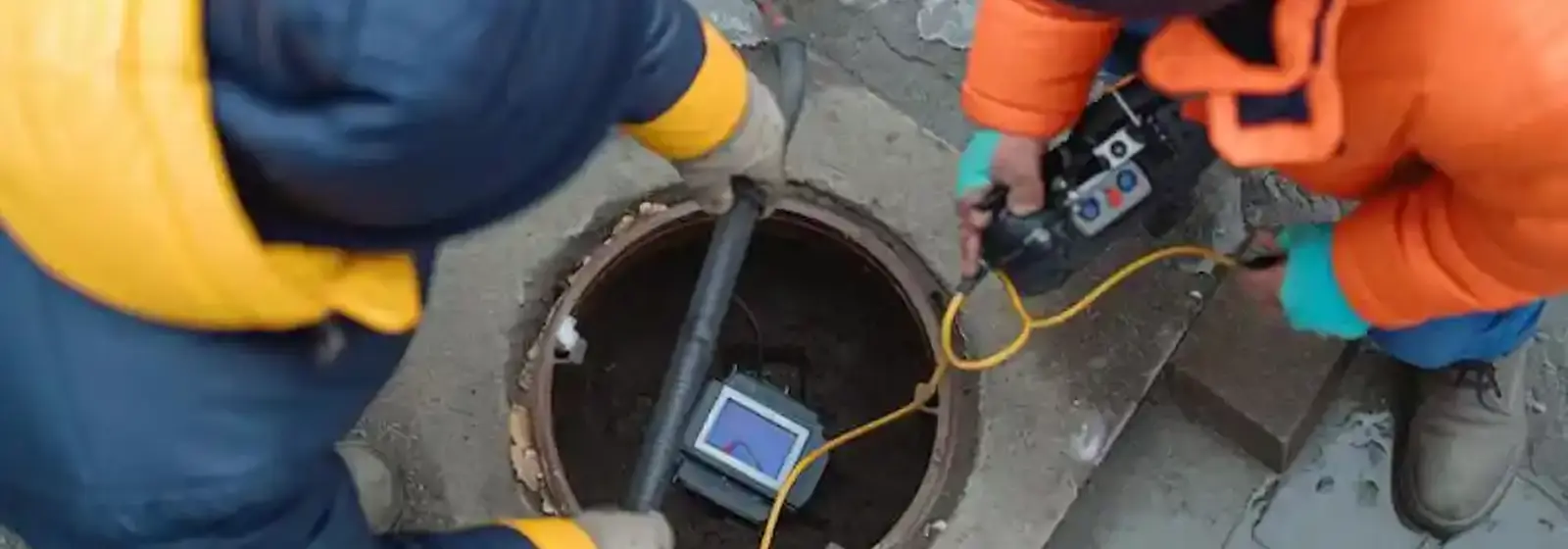
Get one when you buy a home, when drains back up or run slow in several fixtures, when you smell sewage or when you plan a remodel that adds plumbing. It is also worth doing before you pay for a repair, since the camera shows the exact location and condition of the problem.
This guide explains how an inspection works, what the common findings mean and what usually happens next.
How an inspection works
What happens on the visit
- The plumber finds an access point, usually a cleanout or a removed toilet.
- The camera head on a flexible cable goes into the line with lights on.
- A monitor shows the live picture and the plumber notes problems as the camera moves.
- A locator can mark the depth and position of the line above ground.
- You get an explanation of what was found and what it means.
Ask for a recording or screenshots if you are buying a home or need to show someone else. Our sewer inspection page describes what we provide.
What the camera can find
| Finding | What it is | Usual next step |
|---|---|---|
| Roots | Fine roots entering a joint or crack | Cutting, then repair if joints are open |
| Belly or sag | A low spot where water and waste pool | Monitor or replace that section |
| Crack or break | A split or collapsed section | Repair or replace the section |
| Offset joint | Two pipe ends out of alignment | Repair at the joint |
| Scale or grease | Buildup that narrows the pipe | Cleaning or hydro jetting |
| Foreign object | Something that should not be there | Retrieve it |
Not every finding needs a repair today. A plumber should tell you which are urgent and which can be watched.
When to get an inspection
Good reasons
- You are buying a home, especially an older one.
- Drains in several fixtures back up or gurgle.
- You smell sewage inside or outside.
- You have had repeated clogs in the main line.
- You see a wet or sunken patch in the yard along the line.
- You are planning a remodel or a basement bathroom.
If the clog is clear but you want to know why it happened, the camera answers it.
What happens after
Depending on the findings, options include cleaning the line, jetting it, spot repair of a section or replacement. Trenchless methods can fix some lines with less digging, and the camera helps decide whether they apply.
See sewer line repair for repair options and sewer line cleaning if the problem is buildup. Permit rules apply to some work, so ask the building department.
Reading a camera report
A good report says where each problem sits, how far along the line it is and how severe it looks. Distances are measured from the access point, and the locator can mark them on the ground. That lets a repair crew dig in the right place or choose a trenchless method.
Ask for a short list in plain words: what is wrong, what is urgent and what can wait. Ask whether the problem is on your property or on the utility side. Where it is on the utility side, the right call is the utility, and where it is on your side, it is yours to fix.
Good questions after an inspection
- How deep is the line at the problem spot?
- Is the damage getting worse, and how fast?
- What are the repair options and what does each involve?
- Does the work need a permit and an inspection?
- Can I see the recording again later?
Preparing for the visit
Make sure the plumber can reach a cleanout or another access point. Clear the area around it. Tell the plumber about past backups, nearby trees and any repairs done before, since that history helps them read the picture.
How defects are classified
Many municipal and commercial inspections follow the NASSCO Pipeline Assessment Certification Program, a widely used standard, to code defects such as cracks, fractures, roots and offsets. A homeowner report does not need that detail, but if a buyer or a utility asks for coded findings, tell the plumber before the inspection starts.
Buying a home
A general home inspection does not usually include a sewer camera. For an older house, it can be a smart add-on, because a failed line is a large expense that is easy to miss. Share the findings with your agent and ask whether repairs can be negotiated before closing.
Fountain note: older streets, newer subdivisions
Fountain was founded in 1859 as a railroad shipping center, and the area around Downtown Fountain is the older part of the city. Newer subdivisions, such as Lorson Ranch and Mesa Ridge, were built more recently. Neighborhoods developed at different times can have different drain materials, and a camera shows what is actually in the ground at your address.
For permit questions on sewer repairs, ask the Pikes Peak Regional Building Department at 719-327-2880.
Questions homeowners ask
Usually under an hour once access is found, depending on line length and conditions.
It can show cracks, breaks and joint issues that leak. It does not locate every leak by itself.
For an older home, it is a good idea.
No. It shows what is wrong so the repair can be right.
Where to go next
To book a camera look, see sewer inspection. If the findings call for work, sewer line repair explains what comes next.
To schedule a camera look, call (719) 530-4349. We inspect lines for homeowners in Fountain, Security-Widefield and near Fort Carson.