
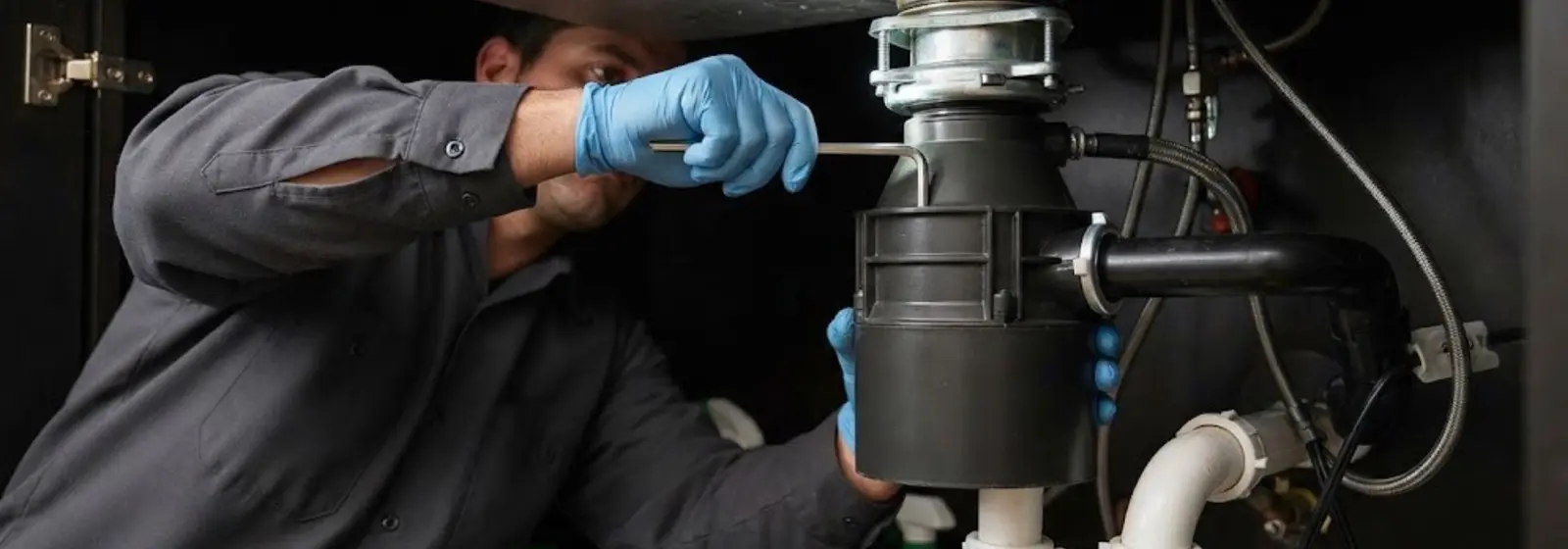
If you are replacing a disposal, you often reuse the existing flange. If you are installing a first disposal, you remove the sink strainer and set the new flange in its place. Either way, the order of steps and the amount of putty matter.
This guide walks through the install, shows common leak points and explains when to call a plumber so the sink and cabinet stay dry.
What the flange does
The flange is the visible ring at the sink drain. Below the sink, a mounting assembly clamps to it, and the disposal hangs from that assembly. The flange keeps water in the drain and keeps the disposal supported.
A good seal at the sink and a tight mount below are what stop leaks. A flange that is not seated evenly will weep water under the sink every time you run the tap.
Before you start
What to gather and check
- The disposal's installation instructions, since mounting designs differ by brand.
- Plumber's putty or the gasket supplied by the manufacturer.
- Basin wrench or pliers, a screwdriver and a bucket.
- A power plan: disposals need an outlet or a switched connection, and wiring is electrician or plumber work.
Unplug the old disposal or switch off its breaker first. Never reach into a disposal. If you are replacing a unit and the old one has jammed, unplug it before touching anything.
Setting the flange
Typical sequence
- Remove the old strainer or flange and clean the sink opening of old putty.
- Roll a rope of plumber's putty and press it around the underside of the new flange lip.
- Press the flange down into the opening so putty squeezes out evenly.
- From below, fit the gasket, backup ring and mounting ring in the order the instructions show.
- Tighten the mounting screws evenly and wipe off the squeezed-out putty.
Do not overtighten. An uneven or overtightened mount can crack the ring or tilt the flange. Let the manufacturer's steps lead, since some brands use different mounting systems.
Hanging the disposal and finishing
Lift the disposal onto the mounting ring and lock it in place. Connect the discharge elbow with its gasket. Connect the dishwasher drain hose if you have one, and knock out the plug in the disposal inlet first. Forgetting the knockout plug is a classic mistake that stops the dishwasher from draining.
Run water, check every joint for drips and run the disposal briefly. Dry the cabinet floor, then look again after a few minutes.
Common leak points
| Leak at | Cause | Fix |
|---|---|---|
| Flange and sink | Not enough putty or uneven seat | Reset the flange with fresh putty |
| Mounting ring | Gasket missing or loose screws | Check gasket, tighten evenly |
| Discharge elbow | Gasket missing or flange loose | Reseat the gasket and bolts |
| Dishwasher hose | Loose clamp | Tighten the clamp |
| Body or bottom | Cracked housing | Replace the unit |
Choosing the right disposal
Disposals differ in horsepower, in how they mount and in how quiet they run. A larger motor handles more and jams less, and a stronger mount holds up better. Feed type matters too. Continuous-feed models run while you push food in, and batch-feed models run only when a stopper is in place.
Motor size
More power grinds tougher scraps and is less likely to jam.
Mounting style
Check that the new unit fits your sink flange or comes with its own.
Noise
Insulated models run quieter.
Feed type
Continuous feed is common. Batch feed adds a safety step.
If you plan to keep the old flange, make sure the new disposal's mount matches it. Many homeowners find it easier to buy the unit with the flange kit it was designed to use.
Safety around a disposal
Always cut the power before you work, and use the switch or breaker, not just the wall switch. Never put your hand into a disposal, even if it seems off. Use tongs or pliers to remove a stuck object, and use the hex wrench slot underneath to free a jammed motor.
After the install, run cold water and test the unit with a few ice cubes. That clears the chamber and shows you whether anything leaks or vibrates.
Where the plumbing code touches a disposal
Many plumbing codes and installation standards call for a dishwasher drain to rise in a high loop or pass through an air gap before it reaches the disposal or the trap. The disposal's instructions show which method suits the unit. It is a small detail that keeps dishwasher water from flowing back.
When to hand it off
Call a plumber if the sink drain is damaged, the pipes do not line up, the disposal needs new wiring or the leak keeps returning. Garbage disposal repair covers jams, leaks and replacement. If water backs up into the other side of a double sink, the problem may be the line, and drain cleaning may be needed.
Fountain note: scale around the sink
Per the city's published figures, hardness runs about 165 ppm from November through April and about 350 ppm from May through October. When you take a kitchen sink apart in a hard-water home, expect scale on the drain parts and old putty that has gone hard.
Clean the opening well before setting a new flange. A clean surface seals better than a crusty one.
Questions homeowners ask
Sometimes, if it is undamaged and matches the new unit. Many brands supply their own.
The flange putty may be thin or the mounting screws uneven. Reset it.
Often yes. Remove the knockout plug so it can drain.
Electrical work has risks. Use a licensed professional if you are unsure.
Where to go next
If your flange leak or jam is beyond a quick fix, see garbage disposal repair. If the sink backs up, read about drain cleaning.
Under-sink leaks are easy to fix when caught early. Reach us at (719) 530-4349 from Fountain, Security-Widefield or near Fort Carson.